

sur le “wokisme”
Don't it always seem to go that you don't know what you got 'til it's gone?

“Woke” used to describe a free thinker who was able to see through ideological haze. But due to some weird cultural movements, “woke” is now almost entirely pejorative, describing a (now potentially dead or dying) mode of discourse that people accuse of being groupthink1.
I think the accusation that there is some level of groupthink happening in the spheres of polite society where people broadly identify as “leftists” for primarily cultural and social reasons stands. However, when so much is at stake in the political climate and the majority of those being accused of “wokeism” are generally on the humanist side, it seems a bad political strategy to concede that there might be something to the accusation.
When talking about “woke” on the scale of an entire political climate, it is best to think in terms of wide averages. Making a cup of coffee will not bring up the temperature of your house. You can burn yourself in the middle of winter. Similarly, one libbed-up elementary school teacher giving a boy detention for not acknowledging that there are more than two genders does not indicate anything about the entire American political climate. The internet distorts our perception of averages. It is very easy to write a story about a single person and very hard to craft a narrative about the banalities of what is happening in classrooms across a country.
I think the thing we ignore in these discourse-generating-stories is that these situations always seem secondary to woke and primarily caused by someone just being a bit of a power tripper. Similarly, if a second-grade teacher in Guntersville is reported to lead her fourth-grade class in the Lord’s Prayer every morning, we should consider this primarily indicative of that teacher’s character, and only secondarily a result of the wider cultural situation. Truly the worst thing about wokeism is that the occasional ridiculous cases served as an available strawman to socially progressive causes.
In fact, I think a space can be quite woke before it’s a problem. My time as an arts major has recently come to an end, and therefore so has my time of having to deal with woke, which I found occasionally annoying but mostly innocuous. In various discussions throughout my undergrad, I was accused of racism, transphobia, xenophobia, and sexism. In all of these scenarios, the accusation was in response to a criticism I had of a critical or logical move an author made, rather than a value statement about the world or politics.
Although it’s a little awkward in the moment to have someone choose to label you as some kind of outgroup rather than engage with your thoughts, it’s really not the end of the world. You have to acknowledge that if you make bold statements about things that are considered impolite to make bold statements about, people will feel uncomfortable. Although I agree that arts education in university should be a place where people can take intellectual risks, having to deal with the way taking those risks will affect how others see you is a part of learning how to take risks, rather than an obstacle. And if someone thinks I’m a bigot, I do think they should be able to tell me that. It’s a little frustrating to talk to someone who insists you shouldn’t think something because it would go against an ideological position, but I don’t think the solution is to make it so those people can’t voice their concerns. The solution to discourse-policing is not more discourse-policing.
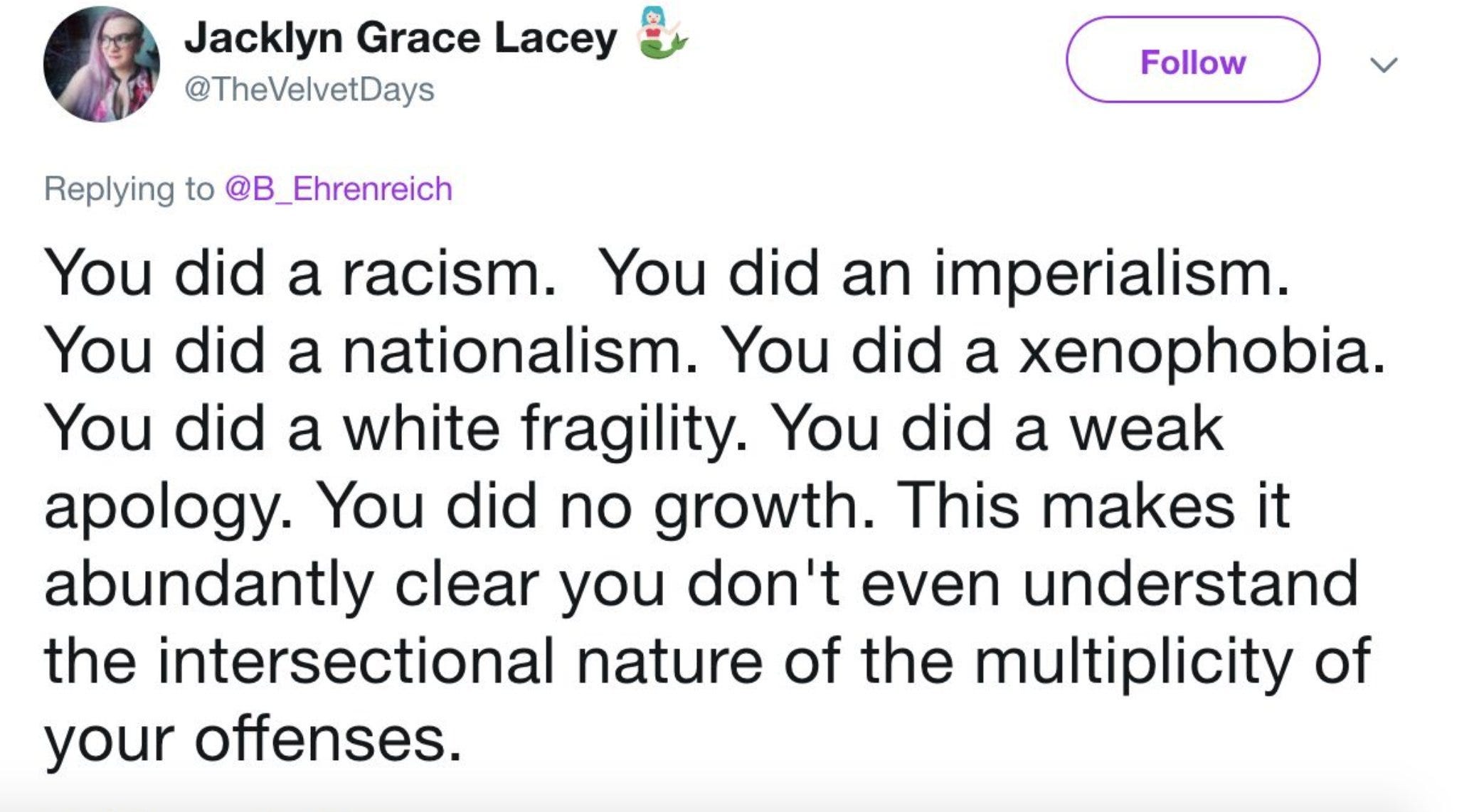
I’m not a fan of commitment to any ideology. A lot of times when I say this, people get frustrated with me because surely everyone has an ideology, insofar as you must believe things about this world in order to navigate it, and any set of beliefs constitutes an ideology, and surely being committed to this ideology is a prerequisite for integrity. I think problems arise when ideology becomes more than the sum of its parts and turns into an idol that must be appeased. I think it’s admirable to be committed to your moral values, but any worldview that sees any outside challenge to your moral values as a foe to be vanquished doesn’t allow for critical thinking. (And everyone likes to talk a big game about the importance of “critical thinking”.) But I think having a particular problem with any ideology proceeds from having a problem with critical thinking, not the other way around.
It’s dead wrong to assume that wokeism is caused by top-down enforcement of values. It might (have) be(en) commonplace for institutions and corporations to implement “woke” policies when that was the popular thing to do, but of course they only did this because it was the popular thing to do. I’m sure there are some cases where someone was forced to do something “woke” by their boss, but I think this is more due to the fact that their boss wanted to avoid public backlash rather than their boss being corrupted by the woke mind virus.
It feels as if I’m a little late to criticize wokeism, given that everyone knows it's no longer the driving cultural force it was a few years ago. But I think there’s enough distance now to look fondly upon it. For as much as I don’t think wokeism is good, the fall of wokism did not result in everyone gaining critical thinking skills. The potential for most people to be captured by groupthink remains. And wokeism is one of the least bad kinds of groupthink out there. As much as it's annoying, it’s at least vested in a vision of justice for all. Wokeism’s replacements have not been so innocuous, and are able to tap into deeper and more violent systems of power than wokeism ever could. I would take wokeism over conservatism any day of the week. You just don’t know what you’ve got till it’s gone.
“woke” is also sometimes used just to generally mean “progressive” but that’s not what I’m talking about here
daily hotfemoid posts > > >